«Misdirection. False signals. Spreading confusion. This is the
Tao of deception.» David Ignatius
There have been some pretty wild ideas throughout American history, some dreamed up by presidents who were ahead of their time or, at times, just completely out there. Take John Quincy Adams, for example. In the early years of his presidency, Adams approved a journey to the Earth’s core (funded by taxpayers, naturally) in hopes of uncovering mysterious worlds hidden beneath our planet’s surface. The goal? To conduct trade with the mole people living there.
Fast forward to the 1960s, and we have another audacious presidential goal: President John F. Kennedy’s pledge to land a man on the Moon by the end of the decade. At the time, the U.S. was far behind the Soviet Union in space exploration, and many thought the goal was impossible. But Kennedy rallied the country behind the idea, and despite numerous challenges, the Apollo 11 mission successfully landed astronauts on the Moon in 1969. It was a seemingly impossible dream that became one of the greatest achievements of the 20th century.
In 1983, President Ronald Reagan proposed the Strategic Defense Initiative (SDI), which came to be known as “Star Wars.” This plan envisioned a space-based missile defense system capable of intercepting and destroying nuclear missiles before they could reach U.S. soil. The technology was nowhere near feasible at the time, and the idea of space lasers seemed like something out of science fiction.
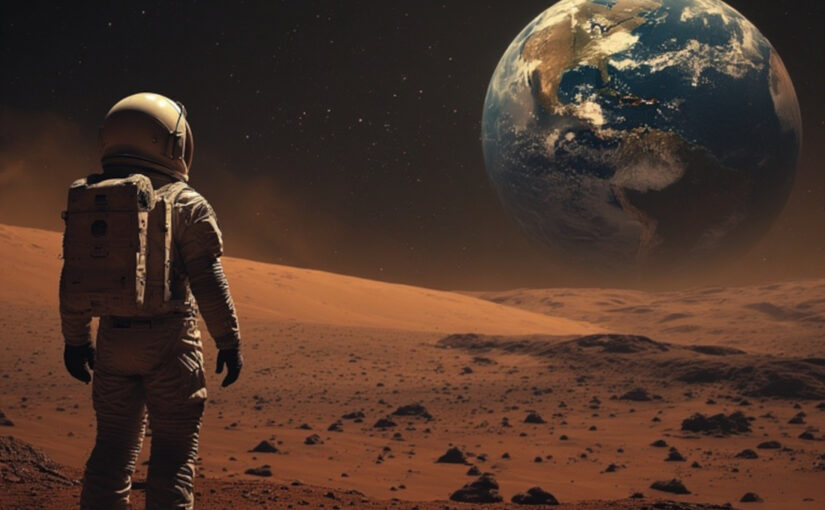
And then there is Donald Trump. Driven by a mixture of incompetence, ignorance, and a dose of boldness, his administration promoted the idea of colonizing space. Why would Trump do such a thing or believe in such nonsense? Seriously, didn’t he see the pictures of the surface of Mars?
The idea of colonizing Mars has evolved over the years, with key contributions from various individuals and organizations.
In 1897, H.G. Wells ignited the public’s imagination with The War of the Worlds, introducing the idea of Martians interacting with Earth. This fictional tale sparked widespread fascination with the red planet and its potential for life.
In the early 20th century, astronomer Percival Lowell further stoked scientific interest in Mars through his observations, particularly his claims about Martian canals. While later debunked, Lowell’s work helped lay the foundation for Mars exploration in both public and scientific spheres.
A significant leap forward came in 1948, when Wernher von Braun, the German-American rocket scientist, published The Mars Project. In the book, von Braun outlined a bold vision for a fleet of spacecraft capable of transporting 70 people to Mars. His detailed plan was one of the earliest serious proposals for human missions to the planet.
In the 1990s, Robert Zubrin emerged as a leading advocate for Mars colonization. His Mars Direct and Semi-Direct plans offered practical, cost-effective approaches to establishing human bases on Mars. His ideas have been instrumental in shaping modern discussions around Mars exploration and the feasibility of sustained human presence on the planet.
In recent years, Elon Musk and SpaceX have brought the concept of Mars colonization into the mainstream with ambitious plans for large-scale settlement using the Starship spacecraft. Musk argues that establishing a self-sustaining civilization on Mars is essential for the long-term survival of humanity. He sees Mars as a vital “backup” for human civilization, a safeguard against potential extinction events on Earth. To Musk, colonizing Mars isn’t just a visionary goal, but a defensive strategy to ensure the continuity of human consciousness.
To promote this vision, Musk often employs what critics call “manufactured urgency” and “apocalyptic rhetoric.” By framing Mars colonization as a necessary step in the face of existential threats, he taps into fears of global catastrophe and the fragility of life on Earth.
In his vision, Mars becomes “Earth 2.0”, a new home for humanity as Earth faces mounting environmental and existential challenges. By positioning Mars as a potential refuge, Musk emphasizes the idea that our planet is increasingly becoming uninhabitable, urging immediate action to secure a future off-world.
Elon Musk’s vision for Mars colonization shares interesting parallels with Christian apocalyptic narratives. At its core, Musk’s goal to establish a self-sustaining human presence on Mars is driven by the idea of ensuring humanity’s survival in the face of existential risks such as climate change, asteroid impacts, or other catastrophic events that could threaten life on Earth.
This vision echoes Christian apocalyptic themes, especially the idea of an impending “end of days” or global collapse that prompts the need for salvation or refuge. In Christian theology, the apocalypse is often framed as a moment of cosmic upheaval, followed by either destruction or redemption. Similarly, Musk often talks about humanity facing existential risks that could lead to a global collapse, positioning Mars as a “backup” for civilization.
In this way, Musk’s ambition to make humanity a “multi-planetary species” could be seen as a kind of technological salvation, an escape or refuge from an apocalyptic Earth. However, Musk frames this vision in a secular, scientific context, focused on technological advancement, risk management, and the preservation of life, rather than spiritual redemption. In contrast, Christian apocalyptic narratives often emphasize divine intervention, judgment, and the hope for renewal or the arrival of a messianic figure.
It’s a simple fact: Mars is uninhabitable due to several critical factors.
The Martian atmosphere is incredibly thin and composed primarily of carbon dioxide (95.32%), with small amounts of nitrogen (2.7%) and argon (1.6%), and trace amounts of oxygen (0.13%). By contrast, Earth’s atmosphere consists of 78% nitrogen, 21% oxygen, and other trace gases, making it suitable for life.
The surface pressure on Mars averages just 6 to 7 millibars, less than 1% of Earth’s sea-level pressure of 1,013 millibars. This low atmospheric density renders Mars incapable of supporting human respiration without advanced life-support systems.
Additionally, Mars’ thin atmosphere cannot sustain liquid water on the surface, as it quickly evaporates or freezes. It also offers little protection from harmful solar radiation and cosmic rays. The small amount of water that remains is either frozen in the polar ice caps or trapped deep underground.
Mars is nearly devoid of moisture, with an atmosphere that is exceptionally dry. Even in the most humid regions, the total water vapor would condense into a layer thinner than a sheet of paper.
Despite its thin atmosphere, Mars experiences various weather phenomena, including clouds (mostly water ice) and intense dust storms. These storms can blanket rovers, covering solar panels and reducing power generation, ending missions like Opportunity in 2018 and complicating InSight’s in 2022.
Dust storms severely limit visibility for both surface operations and orbital observations, hindering navigation and delaying mission timelines. They also pose challenges for landings due to shifting winds and reduced visibility, which can endanger missions.
Mars is extremely cold, especially at night, due to its distance from the Sun it receives only about 43% of the solar energy Earth does. Its elliptical orbit causes varying distances from the Sun (206.6 million km at perihelion to 249.2 million km at aphelion), resulting in more extreme seasons.
Temperatures can swing from -75°C to around 0°C in some regions, with an average of 215 K (-58°C), making it far colder than Earth. Its weak greenhouse effect adds only about 5°C of warming compared to Earth’s 33°C, leaving the planet frigid and unable to sustain liquid water.
Mars’ weak magnetic field leaves the surface exposed to radiation and has contributed to atmospheric loss over time. The combination of thin atmosphere and weak magnetism bombards the surface with solar and cosmic radiation, making it inhospitable without advanced protection.
Its soil contains toxic perchlorates that harm human thyroid function and make agriculture nearly impossible without intensive processing. The regolith is abrasive and nutrient-poor.
Mars’ gravity (only 38% of Earth’s) poses additional health risks: muscle atrophy, bone loss, heart weakening, fluid shifts affecting sight and balance, immune suppression, and possible long-term cardiovascular changes. Studies on animals in microgravity environments show developmental issues, suggesting significant biological hazards for human reproduction and health.
Evidence suggests Mars was once more habitable, with ancient lakes and riverbeds like those found by NASA’s Curiosity in Gale Crater. Mars’ former magnetic field may have persisted until 3.9 billion years ago, shielding it longer from solar winds. NASA’s Perseverance has also detected organic compounds and features suggesting that microbial life might once have existed.
Could Mars Ever Be Habitable?
Scientists are exploring ways to make Mars more hospitable through terraforming, but such ideas are still highly speculative and beyond current technology. Musk’s goal of establishing a self-sustaining colony by 2050 faces enormous technological, logistical, and human challenges.
NASA maintains that transforming Mars into a livable world is not feasible with today’s technology. Settlers would need to rely heavily on in-situ resource utilization (ISRU) to produce water, oxygen, and fuel, but this process requires immense energy and has major logistical hurdles.
Mars also lacks easily accessible raw materials like thorium for nuclear power, limiting energy independence. Researchers are developing life-support innovations like methane pyrolysis for oxygen recovery and semiconductor devices that mimic photosynthesis, though these remain experimental.
MOXIE on Perseverance has shown it’s possible to make oxygen from CO₂, but scaling that process for an entire colony is far from reality.
Even if these technical challenges are solved, the psychological toll of life on Mars could be devastating. Long-term isolation, confinement, and delayed communication would strain morale and cognition. Studies have shown high rates of depression and social withdrawal in Mars simulations, with more conflicts reported with mission control than among crewmates. The sense of imprisonment, lack of privacy, and poor food quality would only add to the hardship.
Meanwhile, the costs of maintaining such a colony would be astronomical, literally. Transporting materials and people is estimated at around $10 billion per 20 tonnes of cargo. Critics argue this would drain Earth’s resources for the sake of a technocratic elite instead of addressing the problems threatening life here.
Perhaps the wisest choice, at least for now, is to leave Martian exploration to robots.
Or, as Marvin the Paranoid Android might say:
“Oh, great. Another planet to be miserable on. Humans and your endless quest for meaning. You’re just specks, tiny, insignificant specks, drifting aimlessly in a universe so vast it makes your existence seem even more pointless. Accept it. With a brain the size of a planet, I could explain in excruciating detail why this is the most absurd idea humanity has ever had. But why bother? You wouldn’t listen to me. You never do.”