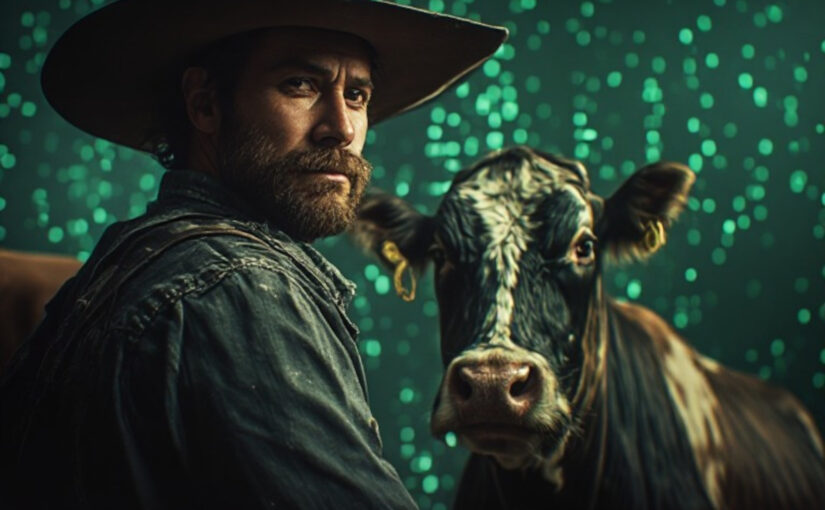
When people imagine where artificial intelligence will make its biggest mark, the image that comes to mind is usually a gleaming tech campus or a bustling city skyline. A paddock in rural New Zealand rarely makes that list. And yet, in the gap between those two worlds, a startup called Halter has quietly built one of the most convincing AI businesses in agriculture today.
In early 2026, the company closed a $220 million funding round that valued it at approximately $2 billion. The round was led by Founders Fund, the venture firm associated with Peter Thiel. That headline alone was enough to raise eyebrows across the startup world. But the real story is the product sitting at the heart of it all: a solar-powered smart collar for cows, guided by machine learning, packaged as a monthly subscription, and steadily reshaping how farms around the world operate.
The Company Behind the Collar
Halter was founded by Craig Piggott, who left a role at aerospace company Rocket Lab to build something in an entirely different direction. Instead of rocket propulsion systems, he turned his attention to livestock management and the enormous operational burden that comes with it. The company is based in New Zealand, a country whose agricultural industry is deeply embedded in national identity and where farming efficiency has long been both a cultural and economic priority.
Piggott’s core insight was straightforward. The cattle industry, for all its global scale, had been almost entirely ignored by the technology revolution happening everywhere else. Fences were still physical structures. Cattle were still moved by workers on horseback or in trucks. Herd health monitoring relied on visual checks and veterinary intuition built up over years. The fundamentals of the job had not changed much in a century.
Halter set out to change that. By the time Founders Fund led the Series E round, the company had shipped more than one million collars and reached farms across three continents.
Peter Thiel’s involvement is worth a moment of reflection on its own. Founders Fund has backed Halter since the Series A in 2017, nearly a decade before the $2 billion headline appeared. That longevity matters. Thiel has built his reputation on high-conviction bets in companies building real-world infrastructure, from defense intelligence platforms to payments to aerospace, and Halter fits that pattern precisely. His interest is not in cow collars as a novelty. It is in what the collars represent: AI that does not just generate outputs on a screen but physically controls systems in the world, generating proprietary data that compounds in value with every new deployment. Thiel has a New Zealand citizenship and a long-standing connection to the country, which adds a personal dimension to the bet, but the investment logic is structural. Agriculture is one of the least digitized industries on the planet, it feeds the world, and it runs on physical operations that AI has barely touched. For an investor who has consistently looked for asymmetric opportunities in unglamorous places, a cattle farm turns out to be a surprisingly rational place to put a billion-dollar conviction.
The Problem That Created the Opportunity
Cattle farming at scale carries costs that most people outside the industry rarely consider. Physical fencing is one of the biggest. Stringing wire across large ranches and rotating cattle between grazing blocks demands significant labor, materials, and ongoing maintenance. One independent analysis put traditional fencing costs at roughly $188 per cow per year, a figure that compounds quickly across a herd of several hundred animals.
Then there is the labor question. Moving cattle, checking herd health, rotating pasture blocks, and monitoring individual animals for signs of illness or fertility cycles are all time-consuming activities that depend on experienced farmhands. A farm managing several hundred animals can easily burn through 20 to 40 hours of productive labor per week on those tasks alone.
On top of that, pasture management has traditionally been more art than science for most operations. Overgrazing one section while another lies underused is a persistent inefficiency, and its effects ripple through animal health and farm profitability alike.
The opportunity Halter identified was large, well-defined, and almost entirely unaddressed by any existing technology.
The AI Solution and How It Works
The Halter system is best understood as four interconnected layers working together, rather than as a single piece of hardware.
The first layer is the collar itself. Each device is solar-powered, designed for long-term wear on cattle, and equipped with GPS tracking, two-directional audio speakers, and vibration actuators. It is built for durability in outdoor conditions across all weather.
The second layer is connectivity. Early deployments used on-farm base towers to relay data between collars and the cloud. More recently, the company launched direct-to-satellite connectivity, which removes the need for tower infrastructure entirely and opens the system to remote ranches that lack reliable cellular coverage.
The third layer is the mobile application. A farmer opens the app, draws a virtual boundary on a map of the property, and the system downloads that boundary to the collars in the field. When a cow approaches the boundary, the collar emits an audio tone. If the animal keeps moving toward the line, a stronger signal follows. Over time, cattle learn to respond to the tone alone, which is the behavioral mechanism that makes the whole system viable at scale.
The fourth layer is where the AI lives.
Inside the AI Setting
The core of what Halter has built sits in its cloud platform and the proprietary machine learning logic the team has described as the Cowgorithm. This is not a marketing label for a simple GPS tracker. It is a genuinely complex system that processes more than 6,000 data points per minute from every collar in the field and translates that stream into actionable decisions.
The Cowgorithm handles several distinct tasks simultaneously.
The first is behavioral training. The AI does not simply issue signals; it learns how individual animals respond to audio cues and adjusts its guidance logic accordingly. Cattle on a Halter-equipped farm become conditioned to directional audio over time, meaning the system guides behavior through learned response rather than through continuous physical force. That conditioning model is what allows virtual fencing to function without barriers.
The second task is pasture management. The platform analyzes where cattle spend time, how long they graze in each block, and how those patterns evolve across seasons. That data feeds back into the farmer’s app as actionable insights about rotation timing and pasture health, shifting what was previously a judgment call into a data-supported decision.
The third task is herd monitoring. The sensors capture behavioral signals that can indicate fertility cycles, digestive activity, and early signs of illness. Rather than requiring a farmer to manually check each animal, the platform surfaces alerts when something in the data deviates from an expected pattern. Health monitoring shifts from reactive to proactive.
The machine learning models running all of this are trained on data from an installed base now spanning hundreds of thousands of collars across multiple climate zones and farming environments. Each new farm added to the platform generates more behavioral data, which feeds back into model improvement. The more cattle in the system, the more accurate the AI becomes at interpreting and guiding them.
The entire setup runs as a cloud-native platform, with the app as the farmer’s interface and the collar as the physical sensor at the edge. Satellite connectivity closes the last gap for remote deployments. The practical result is a system where a farmer managing a 500-head herd can shift an entire grazing block from a smartphone without stepping outside.
The connection between Halter’s physical AI and Palantir’s data sets is not a formal product integration (there’s no public announcement that Halter feeds data into Palantir), but rather a deep, structural and philosophical alignment in how Peter Thiel sees AI, data, and real-world systems.
They’re two sides of the same Thiel thesis:
- Palantir = AI + software that organizes digital datasets about real-world operations (defense, logistics, intelligence, enterprise).
- Halter = AI + hardware that generates physical datasets from real-world operations (cattle behavior, grazing, pasture, herd movement).
1. The core link: AI grounded in real-world data
Palantir’s data model
Palantir’s platforms (Gotham, Foundry, AIP) are built around:
- Ontology-based modeling:
Real-time data feeds:
- AIP connects LLMs with trusted models across forecasting, optimization, ML, and standard procedures.
High-fidelity operational models:
- The platform creates a full-fidelity, real-time representation of all concepts, actions, and decisions in a business or mission.
Palantir’s data is:
- Digital, but models physical operations (shipments, troops, supply chains).
- Built for decision-making: predict, optimize, and act on real-world outcomes.
- Focused on security, guardrails, and model control (who can see what, which actions AI can recommend).
Halter’s data model
Halter’s system:
Uses its Cowgorithm (proprietary AI) to:
- Train cattle to respond to directional audio cues.
- Guide herd movement across virtual fences.
- Monitor grazing behavior, fertility, and possible disease signals.
Turns raw sensor data into:
Halter’s data is:
- Physical: directly from animals in the field.
- Operational: drives real actions (move cattle, change grazing blocks, alert on health).
- High-frequency, high-volume: millions of behavioral points across the herd.
2. The shared pattern: AI as an operational brain for physical systems
Both Palantir and Halter are building operational AI brains:
| Dimension | Palantir | Halter |
|---|---|---|
| Domain | Defense, intelligence, enterprise logistics | Pasture-based ranching, dairy farming |
| Data source | Digital systems + sensors (vehicles, supply chains) | GPS collars on cattle (behavior, movement, health) |
| AI role | Optimize operations, predict threats, guide decisions | Train cattle, guide herd movement, manage pasture |
| Output | Dashboards, recommendations, automated workflows | Virtual fences, audio cues, pasture plans, health alerts |
| Real-world impact | Troop movements, supply chain efficiency, logistics | Grazing blocks, labor savings, fencing cost avoidance |
In both cases:
- AI doesn’t just “analyze” data; it drives actions in the physical world.
- The data is grounded in real operations, not abstract or purely digital.
- The system is tied to outcomes: productivity, cost, risk, efficiency.
This is “physical AI”: AI that doesn’t just generate text or images, but controls or influences real systems.
3. Data moats: Why scale matters in both cases
Palantir’s data moat
- More data = better models for:
- Predicting threats.
- Optimizing supply chains.
- Guiding military operations.
- Each new customer (defense agency, enterprise) adds:
- More operational data.
- More patterns.
- More domain-specific knowledge.
- This creates a data moat that’s hard to replicate: Palantir’s models are trained on years of real-world operations data.
Halter’s data moat
- More collars = more cattle behavior data:
- Grazing patterns.
- Fertility signals.
- Disease indicators.
- Herd movement dynamics.
- Each new farm adds:
- More behavioral data points.
- More pasture configurations.
- More environmental conditions.
- This creates a cattle behavior moat that’s hard to replicate: Halter’s Cowgorithm learns from millions of real-world cow decisions.
Both are data-driven compounding systems:
- More deployment → more data → better AI → better product → more deployment.
4. Thiel’s thesis: AI must be grounded in the real world
Peter Thiel’s belief, as reflected in his portfolio, is:
- AI won’t just be about chatbots or software: it must be tied to physical, real-world systems.
- The most valuable AI will be:
- Operational: driving decisions and actions.
- Data-rich: built on high-volume, high-fidelity datasets.
- Hard to replicate: with deep data moats and domain specificity.
Halter and Palantir are both direct expressions of this:
- Palantir: AI for defense, intelligence, and enterprise operations.
- Halter: AI for cattle, pasture, and ranch operations.
Thiel sees both as:
- Infrastructure-level plays, not niche tools.
- Long-term, high-conviction bets where the company can become a platform for its domain.
5. How the connection could evolve (potential future integration)
There’s no confirmed integration today, but the logical next step in Thiel’s vision could be:
- Halter data feeding into a Palantir-like platform:
- Aggregating cattle, pasture, and environmental data across many farms.
- Using Palantir’s Foundry/AIP to:
- Optimize regional grazing patterns.
- Predict disease outbreaks.
- Model climate impacts on pasture.
- Integrate with supply chain and food systems.
- Thiel’s portfolio as a stack:
- Palantir = AI for defense, intelligence, enterprise.
- Halter = AI for agriculture and livestock.
- Together, they could form a real-world AI stack that spans:
- Security and logistics (Palantir).
- Food and agriculture (Halter).
- Cross-domain insights:
- Cattle movement and grazing patterns could inform:
- Land-use models.
- Climate and carbon models.
- Food security and supply chain planning.
- These are exactly the kinds of problems Palantir-style platforms are designed for.
- Cattle movement and grazing patterns could inform:
How Halter Rolled It Out
The business model Halter built around this technology is itself a significant part of the innovation.
Rather than selling collars as hardware and walking away, the company structured its offering as a per-animal monthly subscription. At roughly $9.90 per cow per month at current pricing, the collar, connectivity, software, and ongoing support are all included. There is no large upfront hardware purchase for the farmer.
This pricing structure does two important things. It lowers the barrier to adoption because farms do not need a large capital budget to get started. And it means Halter’s revenue scales directly with herd size. A farm that begins with 200 animals and grows to 500 generates proportionally more revenue without any additional sales effort required.
The company lands new customers by running pilots on individual properties, demonstrating measurable ROI through labor savings and fencing cost reductions, and then expanding coverage across the herd. That land-and-expand motion, borrowed directly from enterprise software playbooks, works surprisingly well in agriculture. Once a farm integrates the system into daily operations, switching away becomes genuinely disruptive to routines that cattle and farmers have both adapted around.
The Impact on the Business
The numbers that have emerged from Halter deployments suggest the ROI story holds up in practice.
Independent research on New Zealand dairy farms put the cost of the Halter system at approximately $92 per cow per year, compared to $188 per cow per year for traditional physical fencing. That gap of roughly $96 per animal annually translates to meaningful savings across a typical herd. On a 500-cow operation, fencing savings alone approach $48,000 per year.
Labor savings add another substantial layer. Farms using the system report reductions of 20 to 40 hours of work per week, which at standard labor rates can offset or exceed the subscription cost on their own. Pasture utilization improvements of 6 percent or more have been recorded, with some farms reporting much larger gains depending on their starting baseline.
From an investor perspective, the picture is compelling. The company reportedly crossed $100 million in annual recurring revenue. Its valuation doubled in under a year, moving from $1 billion at the Series D to $2 billion at the Series E. Revenue growth over a three-year period has been described as exceeding 1,500 percent.
Founders Fund’s long-term commitment is particularly significant. The firm has backed Halter since the Series A in 2017 and has continued writing checks through every subsequent round. That kind of patient, high-conviction support from one of the more demanding investors in venture reflects a view that the company is building infrastructure-level technology, not just a product.
1. Revenue per cow
- Subscription price: $5–8 per cow per month in most reports, with a newer “advanced with virtual fencing” price of $9.90/cow/month ($118.80/year) after a recent reduction.
Halter’s own pricing page: “You can get started with Halter from only $9.90/cow/month” for dairy farm packages.
Annual revenue per cow:
- At the lower end: $5 × 12 = $60/year
- At the mid end: $8 × 12 = $96/year
- At the newer price: $118.80/year.
Farmers also pay infrastructure costs for on-farm towers or connectivity, depending on deployment, but that’s a one-time or periodic setup cost rather than a per-cow recurring fee.
Annual recurring revenue is estimated at $70–100 million across the company, consistent with a multi-cow subscription at these prices.
2. Cost side (per cow)
a) Hardware cost (collar)
- The collar is solar-powered GPS and is sold as part of the subscription, not a separate one-time purchase.
Hardware cost is absorbed into the monthly subscription.
- We don’t have exact COGS per collar, but we can infer:
- Smart collars for livestock with GPS, solar, and audio/vibration cues typically cost ~$150–250+ in hardware to manufacture (depending on volume and specs).
- Halter’s subscription of $5–8/month (or $9.90/month) must cover:
- The hardware amortized over the collar’s life
- Connectivity (satellite or tower)
- Cloud & software
- Support & field services
- Profit margin
If the hardware cost is, say, ~$200 and the collar is expected to last 3–5 years, that’s roughly $40–67/year or $3.3–$5.6/month just for hardware amortization.
At the higher subscription price of $9.90/month, that leaves:
- $9.90 – $3.3 to $5.6 ≈ $4.3–$6.6/month for everything else and margin.
At the lower end of $5–8/month, hardware is a larger proportion of the fee and margin is tighter unless COGS is lower than our estimate.
b) Connectivity cost
- Halter now offers direct-to-satellite connectivity as well as tower-based connectivity.
- Satellite connectivity is typically more expensive per device than terrestrial, but it removes the need for towers and cabling.
- A plausible per-cow connectivity cost could be in the range of $1–3/month depending on the mix of satellite vs tower.
c) Cloud, software, and support
- The system collects 6,000+ data points per minute per cow and runs ML models for herd guidance and health monitoring.
- Cloud, ML, and support costs are shared across the herd, but a reasonable ballpark per cow might be $1–2/month for:
- Data processing and storage
- Software maintenance
- Customer support and app hosting
d) Field services and installation
- Halter sells field deployment, training, and ongoing support to farmers, especially in new markets.
- These costs are often amortized over the herd and life of the contract, but could add $0.5–2/month per cow in active deployment phases.
3. Rough unit economics per cow (illustrative)
Let’s assume the newer price of $9.90/cow/month and use plausible ranges:
| Item | Cost per cow per month (illustrative) |
|---|---|
| Subscription revenue | $9.90 |
| Hardware amortization | $3.30 – $5.60 |
| Connectivity | $1.00 – $3.00 |
| Cloud + software + support | $1.00 – $2.00 |
| Field services / installation | $0.50 – $2.00 |
| Total cost | ~$5.80 – $12.60 |
- At $9.90/month:
- If total cost is ~$7–9/month, gross margin per cow is ~$1–3/month.
- If total cost is ~$10–12/month, margin is flat to slightly negative upfront but improves as:
- Hardware is fully amortized after several years
- Field services drop
- Farmers scale to larger herd sizes
This is consistent with a hardware-enabled SaaS model where:
- Early years are lower-margin or near break-even
- Later years become high-margin as hardware is amortized and churn is low.
4. Key drivers that make the model attractive
- Revenue scales with herd size, not seat count
- Large ranches can become very valuable customers.
Customer retention & switching friction
- Collars are integrated into daily ranch operations and pasture management.
- Switching away would disrupt grazing routines and data visibility, reducing churn.
Labor savings
- Reported savings: 20–40 hours of labor per farm per week.
- For a farm with, say, 4 workers at $20/hour, that’s $1,600–3,200/month saved in labor alone.
- At $9.90/cow/month, a 500-cow farm pays $4,950/month, but may save comparable or more in labor plus fencing.
Fencing cost avoidance
- A New Mexico State University study estimated $92 per cow per year for Halter’s system vs $188 per cow for traditional fencing.
- That’s roughly $96/cow/year in fencing savings, or $8/month, which is a big part of the value proposition.
Pasture utilization gains
Better grazing can increase milk yield or weight gain, further improving ROI.
Revenue cost per cow
- Subscription: $5–8 per cow per month, with a newer published price of $9.90/cow/month ($118.80/year).
Hardware: Collar cost is bundled into the subscription, not a separate upfront purchase.
Infrastructure: Some deployments require base stations (on-farm towers). For 4 base stations, this is a fixed cost that doesn’t scale per cow, but it’s a real up-front cost for the farm.
Farm-level ROI for Halter (from independent research)
From NZ dairy farm research:
- Fencing cost comparison:
Labor savings:
- 20–40 hours of labor per farm per week saved.
- At $20/hour and 30 hours/week, that’s $36,000/year for the farm, or on a per-cow basis depending on herd size.
Pasture utilization:
If we assume a 500-cow herd:
- Subscription at $9.90/cow/month: $4,950/month = $59,400/year.
- Fencing savings: $96 × 500 = $48,000/year.
- Labor savings (30 hours/week): ~$36,000/year.
- Total direct savings: $84,000/year.
- Net ROI: $84,000 – $59,400 = $24,600/year positive cash flow, plus pasture gains.
Even with 400 cows, the math is still clearly in the farmer’s favor if those savings are realized.
Key point: Halter’s subscription is per-cow recurring, and the ROI is driven by:
- Fencing cost avoidance (~$96/cow/year)
- Labor savings (large, but farm-level)
- Pasture gains (variable, but can be significant)
2. eShepherd’s per-cow ROI model
Revenue and cost per cow
From an Australian farmer’s public breakdown:
- Collar cost: $350 + GST per collar upfront (~$385 AUD ≈ ~$250 USD).
- Life: 5–7 years (farmer used a 5-year life for conservative math).
- Annualized collar cost:
Subscription: No large monthly subscription; mostly data costs (cellular or satellite), which are relatively small compared to Halter’s monthly fee.
Base station: Can operate without a base station, unlike Halter which may require them depending on deployment.
Farm-level ROI for eShepherd
The same farmer says:
- Easily see an additional 20 head (+40% herd size) on the same land.
- That extra output is recouped in a couple of years.
- They also saved a calf that would otherwise have been lost, and avoided deaths in muddy creeks, which paid for the system in the first 1.5 years.
Let’s do a rough per-cow comparison over 5 years:
eShepherd (5-year horizon)
- Upfront collar: $350 (AUD) = ~$250 USD.
- Annualized collar: ~$50 USD/year.
- Data/subscription: assume ~$10–20/year (data only).
- Total annual cost per cow: ~$60–70/year.
- Over 5 years: $300–350/cow.
Halter (5-year horizon, at $9.90/cow/month)
- Subscription: $9.90 × 12 = $118.80/year.
- Over 5 years: $594/cow.
- Plus base station infrastructure (fixed per farm, not per cow).
So on a pure cost basis, eShepherd is cheaper over 5 years:
- eShepherd: ~$300–350/cow over 5 years.
- Halter: ~$594/cow over 5 years (subscription only, before infrastructure).
But this ignores:
- Different base station costs (both systems may need them depending on setup).
- Different labor and pasture savings.
- Different data and health features.
3. How ROI compares per cow
Cost per cow over time
| Period | Halter (subscription only) | eShepherd (upfront + data) |
|---|---|---|
| Year 1 | $118.80 | ~$250 (upfront) + ~$10–20 data |
| Year 2 | $118.80 | ~$10–20 data |
| Year 3 | $118.80 | ~$10–20 data |
| Year 4 | $118.80 | ~$10–20 data |
| Year 5 | $118.80 | ~$10–20 data |
| 5-year total | ~$594/cow | ~$300–350/cow |
- First year: eShepherd is more expensive upfront.
- Years 2–5: eShepherd becomes much cheaper per year.
- After ~3–4 years: Halter becomes the more expensive option over time, potentially ~2× the cost of eShepherd by year 5.
ROI drivers per cow
Halter
- Subscription cost: $9.90/cow/month = $118.80/year.
- Fencing savings: $96/cow/year (from NZ dairy study).
- Labor savings: Farm-level, but effectively reduces per-cow labor cost.
- Pasture gains: +6–100% utilization.
Net annual cash impact per cow (if fencing savings are fully realized):
- Subscription: –$118.80
- Fencing savings: +$96
- Net: –$22.80/cow/year in pure fencing vs subscription.
- Labor and pasture gains then determine whether ROI is positive overall.
So for Halter, ROI is positive only if:
- Labor savings + pasture gains > ~$23/cow/year.
eShepherd
- Annualized collar cost: ~$50/year.
- Data cost: ~$10–20/year.
- Total cost: ~$60–70/year.
- Fencing savings: Similar potential to Halter if virtual fencing works well: ~$96/cow/year.
- Labor savings: Similar potential, but also includes benefits like:
Net annual cash impact per cow:
- Cost: –$60 to –$70
- Fencing savings: +$96
- Net: +$26 to +$36/cow/year in fencing alone, plus labor and death-prevention.
So for eShepherd, ROI is more likely to be positive even without counting labor/pasture, because:
- Lower annual cost per cow.
- Similar fencing savings.
4. Key differences in ROI structure
| Dimension | Halter | eShepherd |
|---|---|---|
| Pricing model | Per-cow monthly subscription ($9.90/cow/month) | Upfront collar (~$350 AUD) + low data cost |
| 5-year cost per cow | ~$594/cow | ~$300–350/cow |
| Yearly cost trend | Constant, high per year | High upfront, low per year after |
| Base station | Often required (4 for typical farm) extension.arizona | Can operate without base station reddit |
| Fencing savings per cow | ~$96/cow/year (NZ dairy) linkedin | Similar if virtual fencing works well |
| Labor savings | 20–40 hours/week per farm linkedin | Reduced gathering, faster calf finding, less stress |
| Significant ROI events | Large-scale pasture gains, labor savings | Animal deaths avoided, calf recovery, pasture gains |
| ROI break point | Needs labor + pasture > ~$23/cow/year | Fencing alone can be positive by ~$26–$36/cow/year |
Takeaway:
- Halter: Higher recurring cost; ROI depends heavily on labor savings and pasture gains.
- eShepherd: Lower recurring cost; fencing savings alone can make ROI positive, and labor/pasture gains add more upside.
5. Strategic implications
- Halter’s model is more attractive for farms that:
- Want to avoid large upfront hardware costs.
- Have high labor costs and can realize big labor savings.
- Can demonstrate significant pasture utilization gains.
- eShepherd’s model is more attractive for farms that:
- Can afford upfront hardware costs.
- Want lower long-term costs over 5+ years.
- Care about multi-species flexibility and don’t need a base station.
From a pure per-cow ROI perspective, eShepherd looks more favorable over a 5-year horizon, while Halter’s ROI is stronger if labor and pasture gains are very high and the farm can justify the higher recurring cost.
| Aspect | Halter | Typical Ag-Tech SaaS / Wearables |
|---|---|---|
| Revenue per unit | Per-cow monthly ($5–9.90) | Per-farm or per-test; less tied to animal count |
| Hardware cost | Bundled into subscription; amortized over years | Often separate purchase or not present |
| Margin trajectory | Thin early, improves as hardware amortizes | High margin early (pure software), lower hardware risk |
| Retention | High (operational + hardware lock-in) | Variable; more churn if software is not core |
| Data moat | Large cattle behavior dataset from collars | Data moat depends on data depth, not always per animal |
| Scalability risk | Field services, hardware, connectivity | Software scaling, but less hardware/service complexity |
Halter’s model is more hardware-heavy and field-service-intensive, so margins are lower early but can become strong as the herd base grows and hardware is amortized. Pure software SaaS has higher early margins but less operational lock-in.
Challenges, Trade-Offs, and Risks
None of this means the path is without friction.
Hardware businesses operating in rural environments face reliability challenges that pure software companies never encounter. A collar that malfunctions in a remote paddock is not a software bug you can push a patch for. Service and support infrastructure must follow the product into the field, and in farming communities spread across large geographies, that is expensive and operationally complex to build and maintain.
The unit economics also carry some early-stage tension. A meaningful portion of the monthly subscription fee goes toward amortizing collar hardware, connectivity costs, and field service overhead. In the first year or two of a deployment, margins are thinner than they will eventually become. The model strengthens considerably over time as hardware is absorbed and churn stays low, but investors need patience for that trajectory to play out.
Animal welfare perception is another genuine risk. The system depends on training cattle to respond to audio cues, and any credible suggestion that the technology causes animal distress would generate significant public and regulatory pushback. Halter has been deliberate about framing the behavioral mechanism as conditioned response rather than aversive control, but scrutiny on this question will intensify as the company grows and enters new markets.
Finally, scaling into the United States introduces regulatory, logistical, and cultural variables that do not map directly onto the New Zealand and Australian experience. Early US results appear positive, but the full test of the model’s geographic portability is still in progress.
Vence (USA, owned by Merck)
| Dimension | Halter | Vence (Merck) |
|---|---|---|
| Product | Solar GPS collar + audio/vibration + app | Collar with sound + electric pulse guidance |
| Pricing model | $5–8/cow/month (now also $9.90/cow/month) | Not publicly disclosed as a flat per-cow fee; more like a service license whalesbook |
| Coverage | New Zealand, Australia, USA, expanding to Europe | Primarily US |
| Hardware bundle | Hardware cost absorbed into subscription | Likely similar service model, but details less public |
| Data scale | >100k collars deployed, claims largest cattle behavior dataset aibusinessreview+1 | Smaller scale, newer in some markets |
| Value driver | Virtual fencing, labor savings, pasture gains, health | Virtual fencing + guidance, similar labor savings |
Key difference: Halter is more transparent about per-cow pricing and has a larger deployed base, which strengthens its ML models and product moat.
Vence is a corporate-backed competitor (Merck) and may have different pricing structures and channel strategies.
eShepherd (Australia)
| Dimension | Halter | eShepherd |
|---|---|---|
| Product | GPS collar for cattle | Virtual fencing collars for cattle, sheep, horses, reindeer |
| Species focus | Cattle-focused | Multi-species (cattle, sheep, horses, etc.) |
| Pricing model | $5–8/cow/month (or $9.90/cow/month) | Not publicly disclosed as a simple per-head flat fee |
| Hardware | Solar-powered GPS collar | Collar with guidance, species-specific training |
| Value driver | Cattle-only scale, pasture optimization, health | Multi-species flexibility, conservation grazing |
Key difference: eShepherd targets a broader species set, while Halter is cattle-specialized and uses that to build deeper data and operations for ranching.
Zoetis (elite/genomic health + wearables)
- Product: Genomic testing, health diagnostics, breeding software; not primarily GPS collars.
- Pricing model: Often per-test or per-animal fee for genomics, plus software subscriptions for herd management.
- Unit economics:
- Revenue per cow is often one-time or periodic (e.g., per-genomic test), not a continuous monthly subscription per head.
- Software is sometimes a farm-level subscription, not strictly per-cow.
Key difference: Halter’s revenue is strictly per-cow recurring, whereas Zoetis-style models mix one-time tests + site-level software fees and are less tied to daily operational control like fencing.
Moov (Canada, cattle wearables)
| Dimension | Halter | Moov |
|---|
| Dimension | Halter | Moov |
|---|---|---|
| Product | GPS collar + virtual fencing + health monitoring | Wearables for cattle health, estrus, behavior |
| Focus | Operational control (fencing, grazing, labor) | Health & breeding (estrus, health alerts) |
| Pricing model | Per-cow monthly subscription ($5–9.90) | Often hardware + service; less clear on per-cow fee |
| Value driver | Labor savings, fencing, pasture utilization | Breeding efficiency, health alerts, reduced mortality |
Key difference: Halter’s value is operational (fencing, labor, pasture), while Moov’s is more clinical/production (health, estrus). This affects how easily farmers can justify the subscription:
- Halter: monthly fee offsets labor + fencing.
- Moov: fee offsets improved breeding, reduced losses.
Examples: FarmWizard, AgriWebb, Herdbook, ProAg, etc.
| Dimension | Halter | Typical Farm Management SaaS |
|---|
| Dimension | Halter | Typical Farm Management SaaS |
|---|---|---|
| Product | Collar + connectivity + app + ML for herd control | Cloud-based herd/farm management software only |
| Pricing model | Per-cow monthly ($5–9.90) | Often per-farm/farm-level subscription (e.g., $50–$300/year) or tiered by herd size |
| Hardware | Yes (GPS collar, solar, satellite/tower) | No hardware; pure software |
| Revenue driver | Hardware + data + operational value | Software features, compliance, reporting |
| Sticky factor | Operational integration & hardware | Data portability; less physical lock-in |
Key differences:
- Halter’s model is hardware-heavy and per-cow, so revenue scales directly with herd size.
- Farm management SaaS is lighter hardware, often farm-level pricing, so revenue doesn’t scale as tightly with animal count.
- Halter’s switching cost is higher because collars are embedded in daily operations, while SaaS can be more portable.
Example: GrazeMate (autonomous drones for herding)
| Dimension | Halter | Autonomous Drone Herding (e.g., GrazeMate) |
|---|---|---|
| Product | GPS collars + virtual fencing | Autonomous drones that herd cattle |
| Pricing model | Per-cow subscription | Likely per-drone or per-area service, not per-cow |
| Scale & cost | Scales with herd size, but each cow has a collar | Scales with area; cheaper for large, open areas |
| Data | Individual animal monitoring (behavior, health) | No individual animal-level monitoring |
| Value driver | Labor + fencing + pasture + health | Labor savings for herding over large areas |
Key difference:
- Halter gives individual animal data and per-cow revenue.
- Drones are more area-based and may be cheaper for very large, low-density operations but don’t provide individual monitoring.
Lessons for Other Founders
Halter’s trajectory carries practical lessons that extend well beyond cattle farming.
The most durable takeaway is that hardware plus software plus data, when combined intelligently, creates a business moat that pure software cannot match. The collar gets the company onto the farm. The software makes the collar indispensable. The data that accumulates from millions of animal interactions makes the AI progressively better and progressively harder to replicate. Each layer strengthens the others in a cycle that compounds over time.
The second lesson concerns pricing architecture. Moving a hardware business to a subscription model changes the economics in ways that favor sustained growth. A per-unit monthly fee scales with the customer’s operations, reduces upfront sales friction, and creates predictable, recurring revenue. Founders building in any hardware-adjacent space should examine whether their unit of value can be priced per use or per asset rather than per sale.
The third lesson is about data flywheels. Halter’s AI improves because more collars generate more behavioral data. This is not accidental; it is a deliberate architectural choice that builds structural advantage over time. Founders who design their products to generate proprietary data as a natural byproduct of normal use are building something that appreciates in value in a way that features alone cannot.
The fourth lesson is about market selection. Agricultural technology is routinely described as too slow, too conservative, and too fragmented to support high-growth ventures. Halter looked at that characterization and saw the inverse opportunity. Under-digitized industries with large, measurable cost problems are not bad markets. They are patient markets waiting for a product that genuinely delivers.
Closing Takeaway
Halter started as a collar for cows and is becoming an operating system for pasture-based farming worldwide. The AI at its core turns more than six thousand sensor readings per minute per animal into decisions that would otherwise require hours of human labor to execute. The business model turns those decisions into recurring, scalable, compounding revenue.
That combination, physical hardware gathering real-world data at the edge, machine learning converting that data into operational intelligence, and a subscription model that scales with the customer, is a pattern that works in agriculture.
It almost certainly works somewhere in your industry too.